Monday, October 22, 2007

Leaving Rosneath


We stopped at Rhu (Row) to visit the place where G would have taken the ferry to Rosneath when she visited her friends while staying at Keppoch House.


View back towards Rhu from the old ferry path.

The road from Keppoch still you leads clearly from Rhu and along the old ferry path.


The track is surfaced now but little else has changed. This is the way that G’s carriage would have taken her down to the beach. She could already see the coast at Rosneath on the other side. How excited she must have been at the prospect of seeing her friends and enjoying their good company. Everything I’ve read about the Dunlops from friends, family and visitors tells of their wise, witty conversation, their kindness to everyone rich or poor and their warm hospitality at the manse.

As my shoes crunched on the beach stones, I looked over at Rosneath and thought that this was the first view Georgiana ever had of the place she would remember with such happy memories until the day she died, far away at Fairlawn.

I felt so sad to be leaving.


And that was when I realised that it would have been her last view of Rosneath too - as she stepped out of the ferry on her final visit, soon to begin a new life on the other side of the world. I cried, and wondered if she did too.


BB

Last Day at Easter Garth

The rest of the UK was under torrential rain but we were lucky. Our last day in Scotland was sunny and we explored the old churchyard again, better equipped than the evening before. Mike had his specs with him for deciphering old writing on gravestones. He had also requisitioned his nice white face flannel for cleaning the mud and moss off the stone so we could read the inscription clearly...


CENTRE The gravestone of Rev Robert and Helen Boyle Story.

The remains of the flowers that Jen and I had left at Helen Dunlop’s grave, “from Georgiana’ a year earlier were still there under the brambles. White spring blossom was abundant in the churchyard and midges danced in the sunlight over the clachan stream. A chaffinch sang loudly, a dog barked in the distance and children laughed as they played nearby. In some places, time can stand still...


It was time to leave the manse. Richard and Helena helped us so much with the research and spent a whole evening telling us about the history of ‘Easter Garth’.

When we left, Richard gave me a very special gift. He’s discovered the old rubbish dump for the manse, probably the same one that the family used in 1829. His wonderful collection of glass and earthenware items tells the story of his discoveries so far. The old glass medicine bottle he gave me was clearly designed to have a cork stopper, not a screw cap. Thrown away by some past resident of the house, many years ago. Thank you so much, Richard. Let us know if you’ve made any new finds!


There were still several hours before the flight back to London and every moment was precious so we headed for the other side of the Gareloch.

BB

Friday, September 21, 2007

Roseath re-visited with BB and Mike


Roseneath at last


It was only about a 30 minute drive to Roseneath from Keppoch House (all the way around the banks of the Gareloch) but already the sky was looking ominous so we decided to explore before the rain arrived. We took the path up the hill behind the Clachan, partly to get a good view of the village from above and partly because I felt sure that Georgiana must have enjoyed exactly the same walk many times. The steep fields behind the church can’t have changed at all since she stayed there.


Even on a thundery afternoon, the western isles of Scotland are beautiful. Wild, silvery and open to the sky. We had to walk through farmland and this old gate shows just how slowly time passes in those hills.


From the top of the hill we looked down onto the Clachan. You can see the ruins of the church where Georgiana worshipped and just to the right, the new manse where we would be staying for the next two nights. If you ignore the telephone wires, this view is just as it would have been in 1829.


You can also see how very close the other shore of the Gareloch is at Roseneath. Almost certainly, Georgiana would have used the little ferry when she visited rather than making the long journey around the head of the loch as we had to do. For her, it would have been a short carriage drive from Keppoch House and then a tiny wooden boat across the narrows at Rhu (or ‘Row’), to land on the stony beach at Roseneath.


We went back down to the village and walked to the beach where the ferry used to come and go.


The pathway from the ferry point back up to the Clachan is tarmac now but clearly covers exactly the same route. No-one around and just the trees on either side and birds singing. She must have walked that way so many times.


I sat on the beach there for a while, thinking about how G would have felt when she first set foot in that beautiful spot, just as I had and how she must have compared it with the beach at Augusta – just as I was doing. I also recorded the sound of the loch lapping against the shore – I’ll be able to listen to that when I get home to WA but she only had her memory to rely on.


The old Ferry Inn is still there, a private home now but we took a photo. Those steps up to the inn must have been the first welcome for many travellers in the 19th Century.


Richard Fryer gave us a warm welcome at Easter Garth, the manse that the Storys had built several years after G had left for Australia, when the old one fell into bad disrepair.


The first delight was the garden.


An old gate is still there between the house and the glebe land where the new church stands. I’m not a gate expert but it looks very old. I imagined Georgiana going through the garden and up the hill through this gate, the way we had walked earlier.


Jennifer and I had always wondered whether the new manse stood on the same spot as the old one where G stayed with Helen and her husband, the Rev. Robert Story. Richard told us that they had found clues that this was the case. When Richard and his wife, Helena, did some renovations, they found old rubble under the floor and filling in a wall. It seems unlikely that anyone would have taken the trouble to move house rubble far in an era when they would have to do it with shovels! The new graveyard was the orchard of the old manse so that, too, shows the likely position of the original building.


It was exciting to think that we were going to stay in exactly the place that G had loved so much, and the home that that Helen lived in for many years until her death, bedridden at the end just like her close friend Georgiana.


Our second surprise was the room we were given. Our window looked straight down onto the old churchyard and just a few metres below us was the grave of Helen Boyle Story (Dunlop) – the one that Jennifer and I found on our last visit, hidden under the brambles. I was overwhelmed…
We planned to explore the graveyard the next day and went off for dinner at the castle-like hotel where Jen and I had rested our weary bones a year earlier. And wher Jen had her first (and last!) taste of Scottish kipper for breakfast…


Then we spent the evening reading old books that Richard had kindly provided about the history of the area. I really didn’t want to sleep – it felt so strange to be there and so wonderful – but I slept like a log.


Sunday, August 05, 2007

The Garden's Secret

It didn’t surprise me to hear from Cath that Keppoch House once had its own kitchen garden. We’d already seen the size of the stables so it was clear that Alexander Dunlop was a wealthy man with all that was needed to run a comfortable country home. The kitchen garden has been sold so we peeped through the gates and imagined tidy rows of vegetables and herbs growing there in 1829. The grey, stone wall is high and very long. I hadn’t really noticed just how long until Cath took out a large, old key from her pocket and asked if we would like to see the flower garden. I’m not sure if she noticed the look on my face as I realised that the answer to one of our big mysteries had just been handed to me.


Next to what was the kitchen garden is the most enormous flower garden and beyond that, further down the hill and along the drive, is another walled garden, that was an orchard full of fruit trees in 1829.


There’s something very personal about reading a woman’s diary entry for the morning of her wedding day. Georgiana wrote “I gathered my wedding flowers and put them in their rooms.” It’s always puzzled me. Why would such a genteel young lady have to go and collect wild flowers when there were plenty of servants to do so? I assumed that she’d preferred to gather wild flowers herself because she already loved them – but I worried that her collection might look rather frugal in such a grand setting. How could she possibly collect enough for a wedding display? It seemed unlikely that she’d plundered them from the formal gardens around the house – it really would’ve been bad taste for a guest to do such a thing when the flower beds would probably have been manicured down to the last petal by a gardener. And suddenly I knew!


Such a grand house had a huge walled garden just for growing the cut flowers they needed for display. And so this was where Georgiana went on her wedding morning. Not for the first time on this trip, my breathing was short and I think the dogs could sense my anticipation as I stepped through the same doorway as she did that day under a low, stone lintel and walked into the garden. I wanted the moment to go on forever.


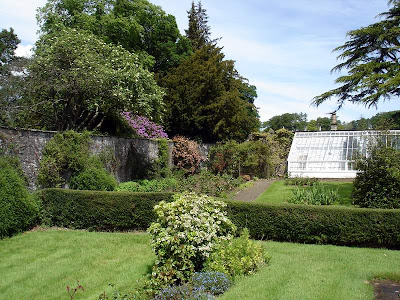
Although the rows and rows of flowers have been replaced largely by beautiful lawns, the basic shape of the garden is the same, with a central path, a sundial and pathways around the sides. The greenhouse looks as if it may be the original one, with heating beneath the brick floor to warm delicate flowers during the cold Scottish spring and autumn. Are there any experts out there who can tell from the photographs? Please let us know if you’re an expert on 19th Century greenhouses! I have some more close-ups of the interior.


Some of the large trees must have been growing there when she last walked in the garden, that same day. This was one of the times when I felt as if she was very close by my shoulder.


It’s such a quiet place and so warm, protected by the high stone walls and facing to the sun. I’m sure she would have thought of this beautiful garden when John laid out her own smaller garden for the first time at Augusta.


In the far wall there was once a doorway, now bricked up with a small statue placed there. You can just see it on the left in the photograph below. In 1829 it led out from the garden and into the forest beyond. What a wonderful escape from the daily life of the house for Georgiana and her friends, the Dunlop girls.


I would have liked to stay longer and to explore more but we had already imposed on Cath’s hospitality beyond anything reasonable so we bade our farewells.


Mike set off in the car but I decided to walk back down to the road on my own. I just wanted to walk away down the drive as G would have done so many times. I wasn’t sure that I would ever go to Keppoch House again. I feel that Georgiana had just that same feeling in 1829.
It was a special walk, something much too personal to try to describe to you. A feeling that felt shared with someone else.


But how could I feel miserable?! We were on our way to Roseneath!


Tuesday, July 10, 2007

Keppoch garden

If anyone wondered why Georgiana loved staying at Keppoch House so much, they would understand if they walked in the gardens.


They must have been more spectacularly manicured in 1829 and probably more formal too, but they couldn’t have been more beautiful than they are now. In the distance, from the hill where the house stands, you can just see Roseneath on the peninsula at the other side of the loch. The gardens slope gently down towards the road and, behind the house and old stables, are the green hills where buzzards and kestrels hunt in a wide, bright sky not unlike the sky of WA. The sounds of birds and squirrels, wind rustling long grasses gently and the dogs occasionally barking are the only things you’ll hear if you take just a few steps away from the house.


Cath gave us the grand tour of the gardens. While she was talking with Mike, I lagged behind whenever I could without seeming rude, just to be alone with my thoughts and to soak in the same sounds that Georgiana would have heard. I veered off along a path through the bluebells and wondered how often her feet had trodden the same steps..


One of the things I wanted to find most was a place where she had been walking in the gardens when she saw John Molloy and her brother, Dalton, driving up in the carriage just prior to the wedding.


It was the beginning of her new life and she recorded the moment in her diary. There are several places where the drive can be clearly seen from the gardens at the front and side of the house. I thought I had found the spot when I stood and looked back down the drive but somehow it didn’t feel quite right.


Then I walked away on my own, along a small, muddy path under the trees and further down in the garden, away from the house. One of the dogs joined me, tugging playfully at my shawl as I explored deeper into the greenery. Mike and Cath’s voices had disappeared altogether. It was very, very still and quiet and the leaves were slippery under my feet.


Something stopped me and I knew that I had to turn and look back – yes, I could just see the driveway through the trees. I knew that this was where Georgiana was standing when she saw her future husband arriving to claim his bride. Perhaps it was a silly thing but I spoke to Georgiana as if she was there with me – it felt almost as if we had shared a secret, as friends do.


But the garden’s best secret was yet to come. I’ll tell you next time how the garden gave us the answer to one of our biggest questions about Georgiana’s wedding and how we found something more special than I could have anticipated!
Here’s a clue….

Wednesday, July 04, 2007

Keppoch House at last!


The next day Mike and I flew to Glasgow airport and hired a car to take us on the last leg of our journey travelling in Georgiana’s footsteps. The last time Jennifer and I were in Scotland we had to leave without being able to visit Keppoch House, where G was living with the Dunlop family when she married John Molloy in 1829.


This time, Mike and I were on our way to see the house, thanks to the eagle eye of Mairi Gallagher who came across our question on the website, ‘Does anyone know who owns Keppoch House? ‘ Mairi alerted Loretta Brodie who got in touch and generously invited us, even though she would not be at home on the day of our visit. Loretta's mother Cath was the thoughtful host who not only gave us the full tour but also provided tea and home made scones and the best carrot cake I’ve EVER tasted. Even the dogs gave us a warm welcome.


I had imagined driving up to the house for the last three years since I began researching G’s life for JAG Films. When we finally arrived at the gate to the driveway I was smiling with anticipation at being in the place that held such special memories for Georgiana.


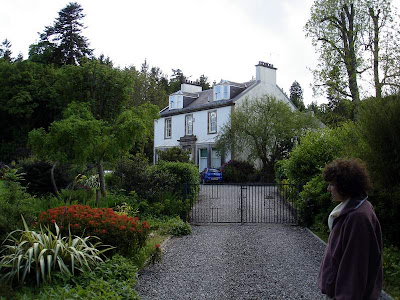
The house is beautiful and, like Crosby Lodge, situated in a stunning position. Behind the house are the hills and in front of it is the southernmost edge of the Gareloch, the loch that G sketched in pencil on the flyleaf of her 1829 diary held at the Battye Library in Perth WA. Perhaps she wanted to keep it in her memory when she left for the new colony.


The building has changed only a little since 1829, with bay windows being added on each side in Victorian times and the ceilings raised on the top floor, but the main rooms inside are the same as they were. Marti Pellow, the singer with the 80’s pop group ‘Wet Wet Wet’ lived in the house for a while and the décor he chose is a bold turn on Scottish traditional but the main internal features are still there.


I almost didn’t want to go into the house! I’d waited so long to be there and read so many, many times what G had written while she was there. I knew that she would be all around me and I was about to see what she saw, walk where she walked and touch what she touched. I knew that I would love the place just as she had and I knew how much she had wanted to go back to see her friends there – but never did.


I could see in my mind’s eye the guests arriving for G and J’s wedding in the large hallway with its huge fireplace and when I realised that the stairway is almost certainly the original one, I took off my 21st century watch and put my hand just where G’s hand would have rested each evening on the bottom curve of the banister rail as she went upstairs to her room.


It was just as when I touched the WA flower samples at Kew Herbarium, that she had sent to Mangles. There is something very moving about touching something that has been touched by another, however many years separate the two actions - something to do with the closeness of the same simple action that doesn’t change with fashion or decades passing. It wasn’t the first time or the last that I felt Georgiana Molloy close, at my side.


It wasn’t hard to imagine what life was like in the house, with the servants’ floor upstairs, the kitchens below and a large stables block nearby for the carriages and horses, but it was a little frustrating not to know every detail I wanted to find out! G could only have been given one of the main bedrooms on the first floor but I had no idea which one.


Not the master bedroom and probably not one of the other front rooms – they were probably the bedrooms of the Dunlop sisters. So I spent a while standing quietly on my own in a side bedroom and took a photograph of the door. I wondered if this was the room where G had spent her last night as Georgiana Kennedy and had written the words in the diary that I read in Perth more than a hundred years later.

The place where Robert Story married the couple was easier to guess as the choices were limited. One of the two main and interconnecting reception rooms, the large hallway itself or the impressive dining room on the front of the house. G writes in her diary, on the morning of the wedding, that she put her bridal flowers ‘in their rooms’ so I think that one room was used for the ceremony and another for the wedding breakfast perhaps. The dining room would have had the right air of formality and the most obvious position is the place where a large sideboard now stands. The place between the windows on the long wall is the obvious position for the buffet that would have held breakfast, luncheon and dinner dishes in 1829 so the same kind of piece of furniture would have stood there.


I felt sure that this is where the wedding took place and I stood quietly again with my thoughts, feeling glad for myself to be there at last and so glad for Georgiana that her marriage with John became such a loving and happy one.
A big thank you to Loretta and Cath who gave up their time to talk with us about the house and its history. You both helped to make it a special day for me.


But I haven’t told you yet about the wonderful surprises that were still waiting for me when I went outside. I was about to get closer to Georgiana than ever before. More next time!